by Bobby McCarthy
Copyright (c), 2003, My Daily Driver -- All Rights Reserved
 The term "classic" car,
 as I understand it, is any vehicle that is at least 15 years old. Where
as "antique" cars are at least 20 years old. At the risk of insulting some folks, I do not consider a
1986 Chrysler Voyager a "classic." It is equally difficult for me to accept a 1981 Chevrolet Citation
as an "antique."
While I'll admit that I am a product of the '70's, I have certainly not remained frozen in that decade.
However, I was baptized into the automotive world with the cars from the 1960's and early '70's. A guy
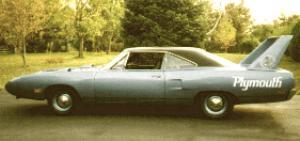
named Edward lived in my neighborhood and drove a '70 Plymouth Superbird. What, are you kidding me?
Someone we knew driving a Superbird to the grocery store? My goodness. If we only had a Time
Machine... Oh yeah, where was I, we used to watch Edward's Petty Blue 'Bird rumbling by and make a
comment like, "What a waste of machinery." Ed wasn't exactly known for his machismo.
Looking back, that Plymouth was practically brand new, so we certainly didn't use the word "classic" to
describe it. But, it was an "instant classic." This is why I rebuke the "15 years a classic" and "20
years an antique" standard. I suppose that back in the day, this standard if not accurate, was at least
appropriate. Since we have survived the passing of the new millenium, I feel it's time to update this.
I know, I know, it's just one of those things. I mean, who really cares about what "they" say? Well,
My Daily Driver.com does, that's who. This publication is dedicated to the drivers of classic cars, so
we'll use our alleged journalistic license to determine what is "classic."
The actual word "classic" means:
a.) Belonging to the highest rank or class.
b.) Serving as the established model or standard.
c.) Having lasting significance or worth; enduring.
Well, being somewhat anti-class and anti-establishment, I like "c", having lasting significance. You may
ask, "Well, Mr. Column Writing Man, what makes a car significant?" I'm glad you asked. We wrestled with
the "what makes a car a classic" scenario and after countless days locked in the bunker, we emerged with
this revelation. Chrome bumpers. Yep, that's it, chrome bumpers. It is a simple equation to a complex
problem. If you drive a 15 year old car that has composite anti-impact devices fused to the rear
sub-frame, you do not drive a "classic" car. Conversely, regardless of what you call transportation, if
you have a big old chrome bumper hanging off of it, it's a classic. To us, the amount of rust, flaking
or yards of duct tape present is non-consequential. It's still a "classic."
"What about the early IROC Z-28's?" or "How 'bout my 1987 Buick Grand National?" Well, these cars are
"significant", and as the Websters Dictionary reads, "classic" is significant. So we do take into
consideration whether a particular car is significant or not. Actually, I think a better word for
significant is "cool." Let's be honest, a 1987 GNX is very cool, an "instant classic." That reminds me
of Ed and his '70 'Bird. Last time I was back in the old neighborhood, Ed was climbing into a tired
Ford Explorer. I was driving my 1971 Dodge and I didn't have the heart to pull over and chat.